Building Organisations That Can Sustain Growth in African Markets
Strategy
Growth holds only when the systems beneath it can carry the load.
Over the last three years, Nigeria has provided an unusually clear view of what happens when growth meets structural fragility.
The naira moved from the N700 - N800/$ range in mid-2023 to above N1,400/$ by mid-2024, with the Central Bank of Nigeria reporting an average NAFEM rate of n1,360/$ in the first half of 2024. Inflation reached 34.8% in December 2024, while the Monetary Policy Rate rose from 18.75% in July 2023 to 27.5% by 2024–25.
These were not simply macroeconomic statistics. They changed the economics of operating: imported inputs became more expensive, financing became harder, consumer purchasing power weakened, and organisations with significant fixed or foreign-currency costs had to make decisions much faster than many of their existing structures were designed to support.
Yet the interesting question is not whether the environment became more difficult. It did.
The more useful question for senior leaders is why organisations exposed to broadly similar conditions experienced such different outcomes.
That is where I think the conversation about sustainable growth needs to move.
A macroeconomic shock can expose organisational weaknesses that were difficult to see when capital was abundant, currencies were more stable and growth could compensate for inefficiency. The shock does not necessarily create those weaknesses. It reveals how much structural fragility the operating model was already carrying.
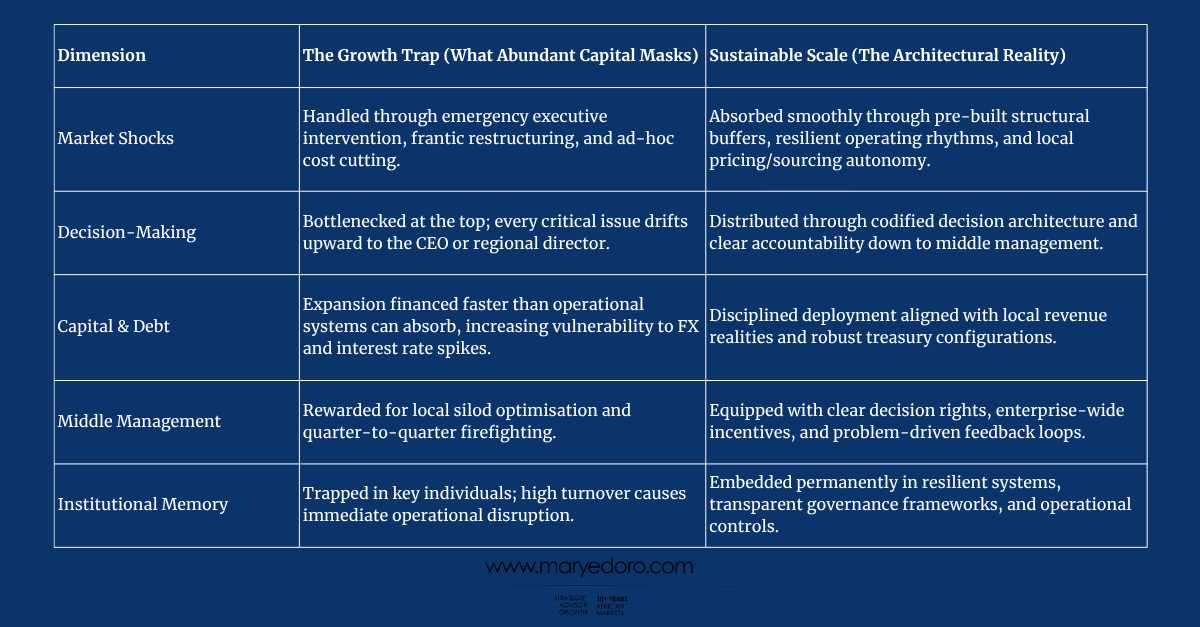
This distinction matters because it changes the leadership response. If the problem is treated only as a market problem, the response will usually be cost reduction, restructuring, fundraising or a new strategy. Sometimes those are necessary. But none addresses the deeper question: can the organisation absorb the next stage of growth, complexity or volatility without becoming increasingly dependent on extraordinary executive intervention?
Growth is not the same as scale
There is a tendency to use growth and scale interchangeably. They are not the same organisational achievement.
An organisation can increase revenue, enter new markets, hire aggressively and attract substantial capital while its underlying institutional capacity remains relatively unchanged. In fact, rapid growth can conceal this for a surprisingly long time.
The African technology ecosystem provides a useful illustration. After the funding peak of 2022, African tech funding contracted sharply through 2023 and 2024. By 2025, total funding had recovered to $4.1 billion, according to Partech. But the recovery was not evenly distributed: debt funding grew 63% year-on-year and rose from 31% to 41% of total capital deployed, while equity funding grew more modestly, at around 8%. Capital was returning, but on more selective, debt-weighted terms than during the 2022 peak.
That distinction matters for leadership teams because capital can finance expansion much faster than an organisation can develop the systems required to manage it.
Twiga Foods is a particularly instructive case, not because its current administration can be reduced to a single cause, but because the company illustrates the difference between commercial ambition and institutional resilience. After years of restructuring and financial pressure, its holding entity entered administration in August 2026, with the filing becoming public in September.
The lesson is not that ambitious growth is inherently flawed. It is that a business model can become increasingly difficult to sustain when the organisational architecture underneath it does not evolve at the same pace as the ambition.
The same principle applies beyond startups.
The operating model eventually becomes the strategy
For multinational organisations operating in frontier and emerging markets, one recurring challenge is the mismatch between global cost structures and local revenue realities.
When inputs, technology, debt or supply chains are priced in hard currency while revenue is generated predominantly in local currency, currency depreciation can fundamentally alter the economics of the business. The organisation may have a strong brand, significant market share and a sound global strategy and still find that the local operating model has become structurally unattractive.
This is part of the context in which companies such as P&G have restructured their international operations; P&G has previously exited manufacturing operations in Nigeria as part of broader changes to its model.
The point is not that every corporate retrenchment in Nigeria or Africa has the same explanation. It does not. Claims that a long list of multinationals simply "left Nigeria because of the business environment," for example, have been challenged by fact-checking because several of those companies did not actually exit the country in the way commonly described.
The more useful strategic question is therefore not, "Is this market difficult?"
It is: "Is our operating model designed for the economics of this market?"
That requires decisions about local sourcing, pricing authority, treasury, supply-chain configuration, asset intensity, talent, regulatory exposure and the degree of autonomy local leadership actually has. These are organisational design questions as much as they are financial ones.
Governance is necessary. It is not sufficient.
As organisations mature, governance inevitably becomes more important. But governance should not be reduced to having a board, policies, committees and compliance processes.
The IFC's Corporate Governance Methodology is useful precisely because it treats governance as a progression rather than a checklist. Its framework examines leadership and culture, board effectiveness, disclosure, minority shareholder treatment, stakeholder engagement and the control environment, including internal controls, audit, risk management and compliance.
This reflects an important reality: institutional maturity is not achieved by adding bureaucracy. It is achieved when decision-making, accountability and risk management become sufficiently embedded that the organisation can operate reliably without every important issue escalating to the top.
That brings us to the part of the organisation that is often discussed least in conversations about scale: the middle.
The middle of the organisation is where strategy becomes real
Senior leaders can establish direction. Boards can establish oversight. But neither can substitute indefinitely for the organisational layer that translates strategy into thousands of decisions.
This is where many organisations encounter a hidden constraint.
A senior manager may understand the company's long-term strategy but still be rewarded primarily for protecting this quarter's numbers. A functional leader may optimise their department while creating friction for the organisation as a whole. A country head may have accountability for results without sufficient decision rights to change the inputs affecting those results.
As the organisation grows, these tensions multiply.
The result is often what looks from the outside like an execution problem. But the underlying issue is frequently unclear decision rights, weak cross-functional coordination, insufficient managerial capability or incentives that reward local optimisation over enterprise outcomes.
This is why training alone rarely solves the problem.
People do not develop institutional capability simply because they attended a leadership programme. Capability develops when people repeatedly have to diagnose problems, make decisions, receive feedback, adapt and carry responsibility for outcomes.
This is also a principle that development practitioners have examined for years. Harvard Kennedy School's Problem Driven Iterative Adaptation approach, for example, emphasises locally defined problems, experimentation, tight feedback loops and learning through implementation rather than simply transferring pre-designed solutions.
There is a useful corporate parallel here.
If an organisation keeps importing consultants, frameworks and training programmes but the same decisions still have to be escalated to the CEO, the institution has acquired knowledge without necessarily acquiring capability. The question senior leaders should be asking.
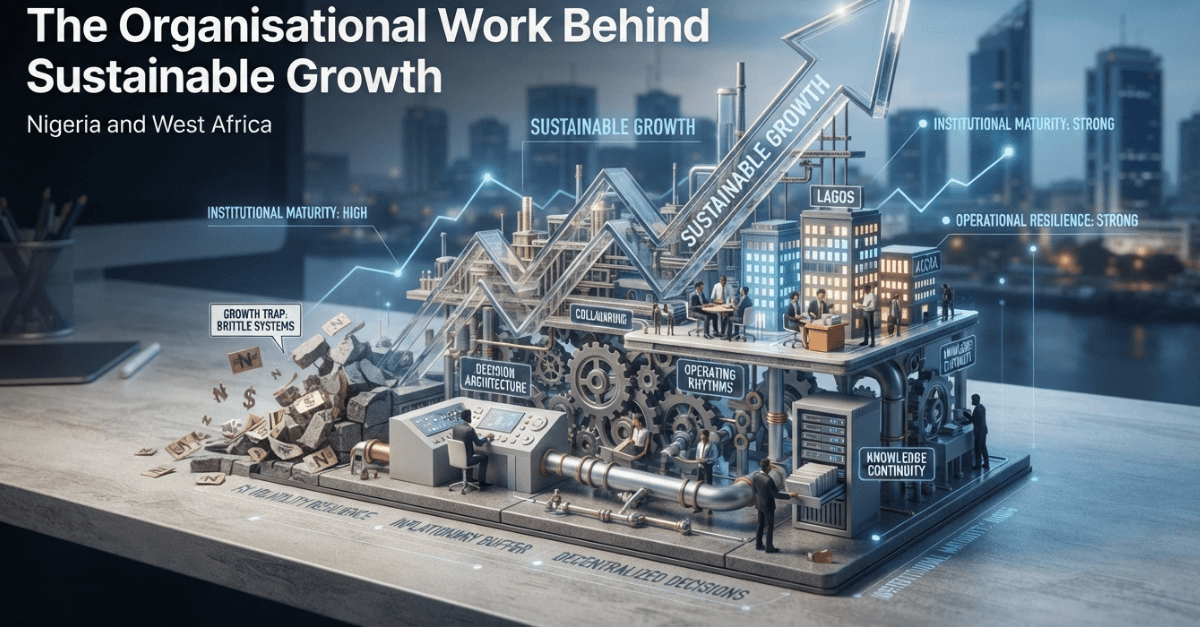
The organisational work behind sustainable growth is therefore less glamorous than growth itself.
It is deciding which decisions belong where. It is building managers who can exercise judgement rather than simply follow instructions. It is designing incentives that encourage enterprise thinking. It is creating financial and operating models that can withstand volatility. It is integrating risk and regulatory foresight into strategy rather than treating them as downstream controls. It is building feedback mechanisms that allow the organisation to learn before a problem becomes a crisis.
Most importantly, it is deliberately reducing the amount of organisational complexity that only the CEO can resolve.
There is a useful test for this.
If the organisation doubles in size tomorrow, what breaks first?
The answer will usually reveal more about its readiness for scale than its growth strategy will.
It may be the finance function. It may be decision-making. It may be middle management. It may be technology, governance, culture or the supply chain. Whatever the answer is, that is where the next phase of institutional investment belongs.
Because sustainable growth is not simply the ability to become bigger.
It is the ability to become more capable as you become bigger.
www.maryedoro.com
The strongest organisations are not those that experience the fewest shocks. They are those whose institutional architecture allows them to absorb shocks, learn from them and continue making good decisions without requiring extraordinary intervention at every level.
This is the layer of work I find most interesting, and where I've spent most of the last decade - inside a fast-scaling organisation, and now through something I am building quietly, working with organisations trying to build this kind of institutional capacity ahead of the next shock rather than in the middle of one.
If you're thinking through a version of this question inside your own organisation, I'd welcome the conversation.
That is the organisational work behind sustainable growth.
Mary Edoro
Strategy · Leadership · Growth
© 2026
